How many IPs does an Egress Server use?
One Egress Server consumes a small, fixed set of IP addresses:
two public IPv4s (one for the Egress Server, one for its UDP
ingress proxy), private IPv4s in its VPC's public subnet, and a
pool of WireGuard peer addresses inside the wg0 tunnel
network. The peer pool is what's visible to
end-users in the Console.
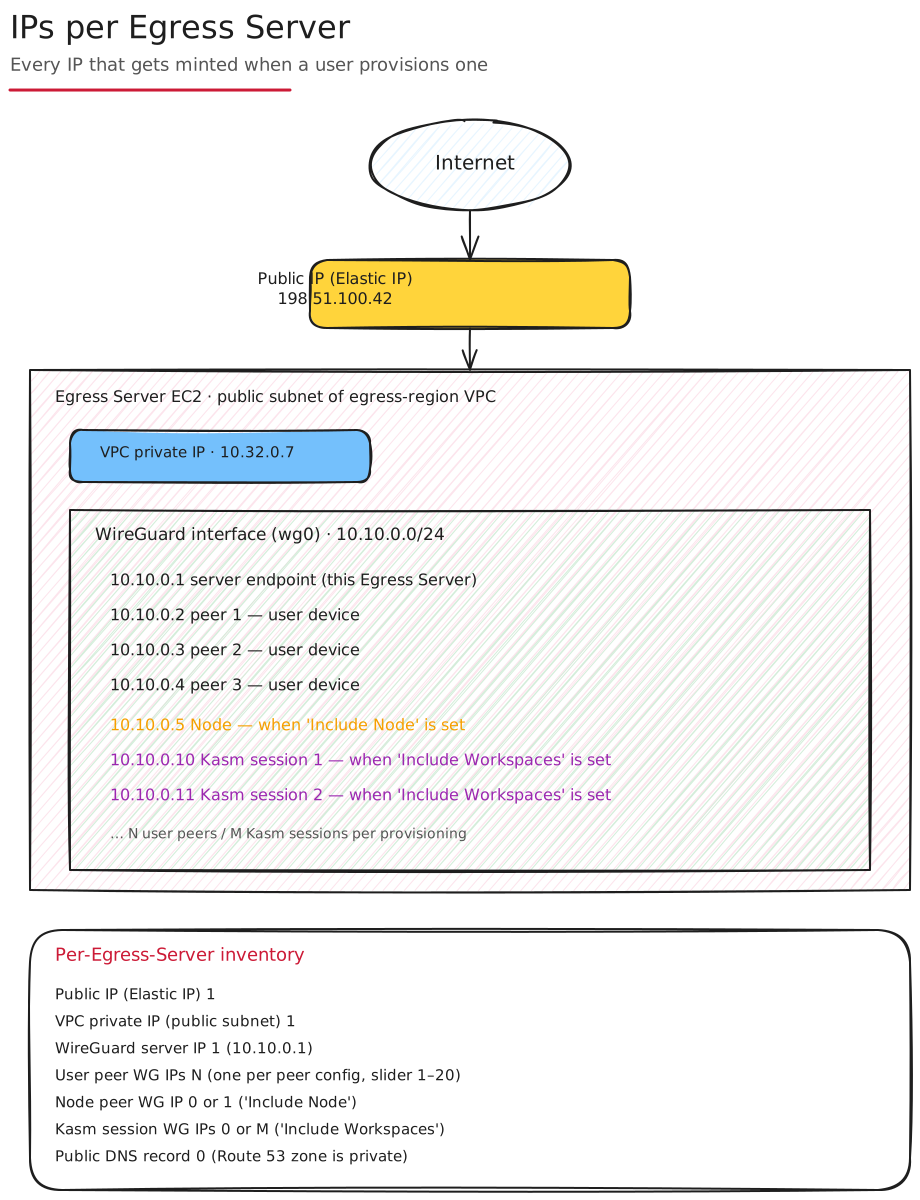
What each IP is for
- Egress public IPv4 — the address every destination sees. Unique to this Egress Server; never shared with another deployment. It's an auto-assigned public IP, not an Elastic IP, so a rebuilt Egress Server gets a new one.
- Ingress public IPv4 (UDP proxy) — the WireGuard endpoint in every peer config, and the only address the local ISP sees. The proxy forwards UDP/51820 to the Egress Server's private IP.
- Private IPv4s in the VPC — used by AWS internal routing and by VPC peering to the home region.
wg0server address (10.0.0.1) — the inside-tunnel identity of the Egress Server itself.wg0peer addresses (10.0.0.2 upwards) — one per peer, assigned in order: user peers (1–20, chosen at provisioning), then Kasm peers (up to 10) if Kasm is enabled, then one Node peer if Node integration is enabled.
A typical Egress Server therefore shows destinations one public
IP and hosts as many WireGuard peers as were requested when it
was provisioned. Multiple Egress Servers are independent — each
has its own tunnel network (they reuse the same 10.0.0.0/24
range), and they don't see each other's traffic.
See also
- How is an Egress Server provisioned? — the saga that allocates these IPs.
- Console → Egress Servers — how users see and manage their peer slots.